


.png)





Portraits and stories of men who were detained by American forces at Abu Ghraib Prison in Iraq.
Since March 2006, Heyman has traveled to Amman, Jordan and Istanbul, Turkey at the invitation of Philadelphia law firm Burke Pyle LLC to participate in interviews that the firm, along with the Center for Constitutional Rights, Human Rights Watch, and Detroit law firm Akeel and Valentine PLC were conducting. The lawyers were gathering evidence for a class action lawsuit on behalf of dormer detainees at Abu Ghraib Prison. Heyman witnessed the interviews and created drypoint prints in an effort to attach personal faces to the Abu Ghraib story.
 Heyman explains his process: "I sit in this hotel room and draw the face of an Iraqi who is telling the most humiliating and degrading story of his life. I try to disappear. I draw, first a small sketch on a scrap of paper, and then a copper plate using a stylus. As I listen and draw, I am also inscribing the words I hear into the copper, backwards. I have to write very quickly, so that I do not loose the thread of the story.”
On view at Kasini House beginning October 12 th will be the Amman Drypoint Print Series and other work by Daniel Heyman
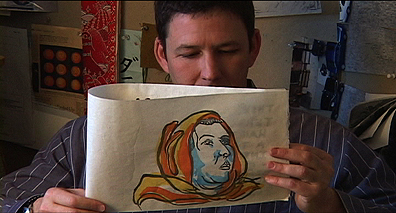
 Heyman sought to create portraits of these men and women to restore their dignity and individuality to the world at large. Most Americans are familiar with the disturbing photographic images in which victims of abuse are hooded, unclothed, and anonymous. In Heyman’s prints, the detainees’ faces, as well as personal details emerge. In the catalog for this body of work, Philadelphia Museum of Art Associate Curator for Prints and Drawings Shelley R. Langdale writes: “…rather than portraying the former prisoners in their victimized state, … here Heyman takes advantage of his first-hand experience to focus on them as people. He reclaims their humanity by showing them seated in suits and ties, shirtsleeves or a patterned shawl, as he encountered them when they related their testimony and spoke of their homes, families and friends.”
Daniel Heyman, Abu Ghraib, Part 1 and Part 2
Artist, Daniel Heyman, flew to the Middle East to witness and record the testimony of former victims of torture at Abu Ghraib through his artwork.
Attorney Susan Burke and a number of other concerned Americans have brought a suit against those responsible for the horror at Abu Ghraib. The torture isn't over and the story isn't over for the victims.
Jacqueline van Rhyn, the curator of an exhibition of Daniel's work at the Print Center, takes us through the show.
Above, outtake of Daniel Heyman reading a page from his book. Music by Beth Quist and DJ Cary.
play Quicktime version (Warning, Graphic Photos)
play YouTube version (Warning, Graphic Photos)
Learn More About
The Print Center - iPod/iTunes video
The Written Word on Daniel Heyman
Anne Fabbri Broad Street Review
Roberta Fallon and Libby Rosof Artblog
Drew Lazor City Paper
credits
Source: Vincent Romaniello


